
The operating problem behind the technology
The strongest smart-home decisions begin with operations. For remote climate control modular home, ask who changes access codes, who sees leak alerts, who resets climate after check-out and who owns device passwords. A smart Mantra is valuable because it can reduce staff visits; a poorly documented smart room can do the opposite.
Guest-facing and owner-facing systems
Guest-facing systems include smart locks, climate presets, lighting and Wi-Fi. Owner-facing systems include humidity, COв‚‚, energy, leak alerts, occupancy, service logs and PMS integration.
Smart stack and model fit
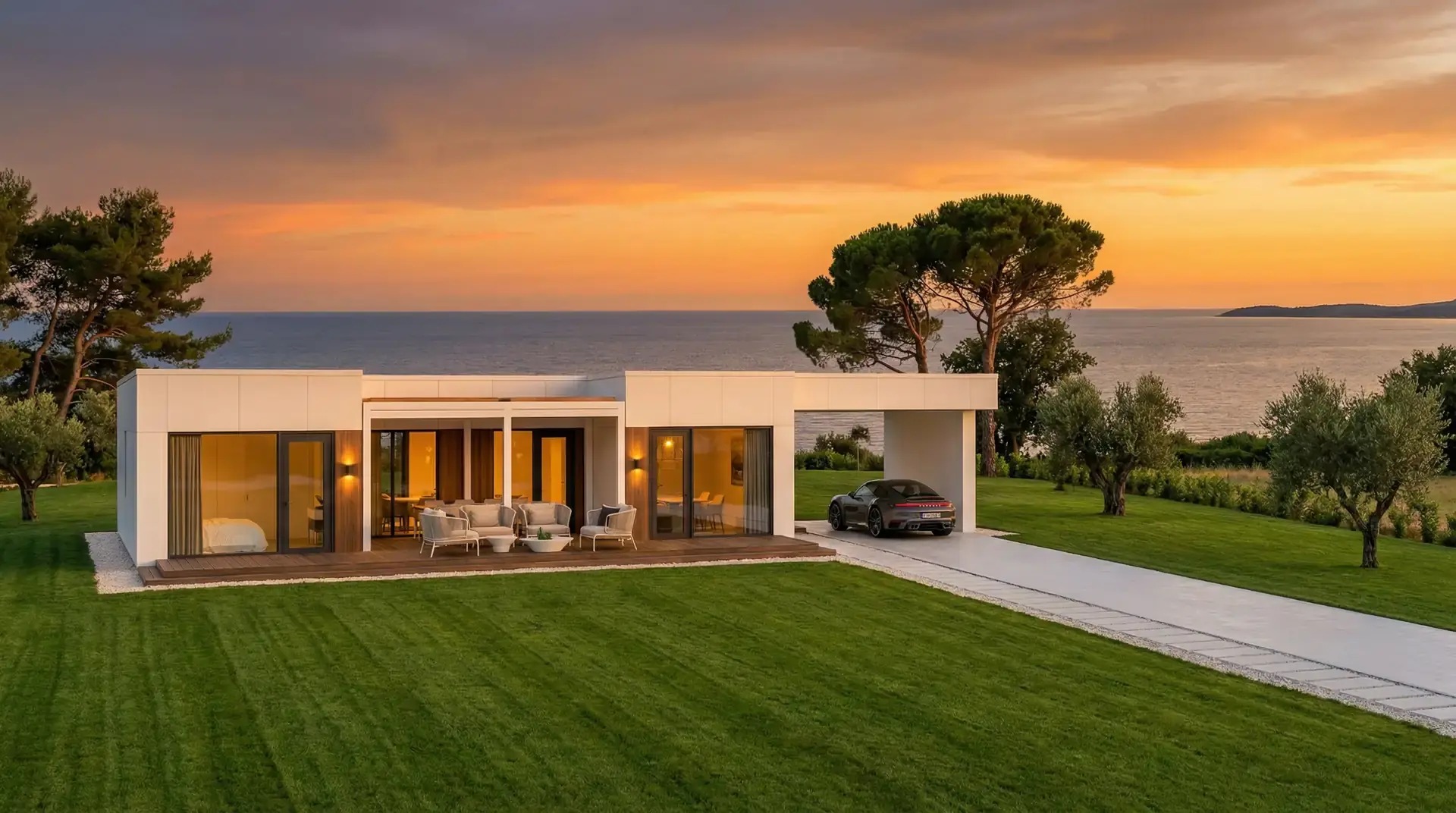
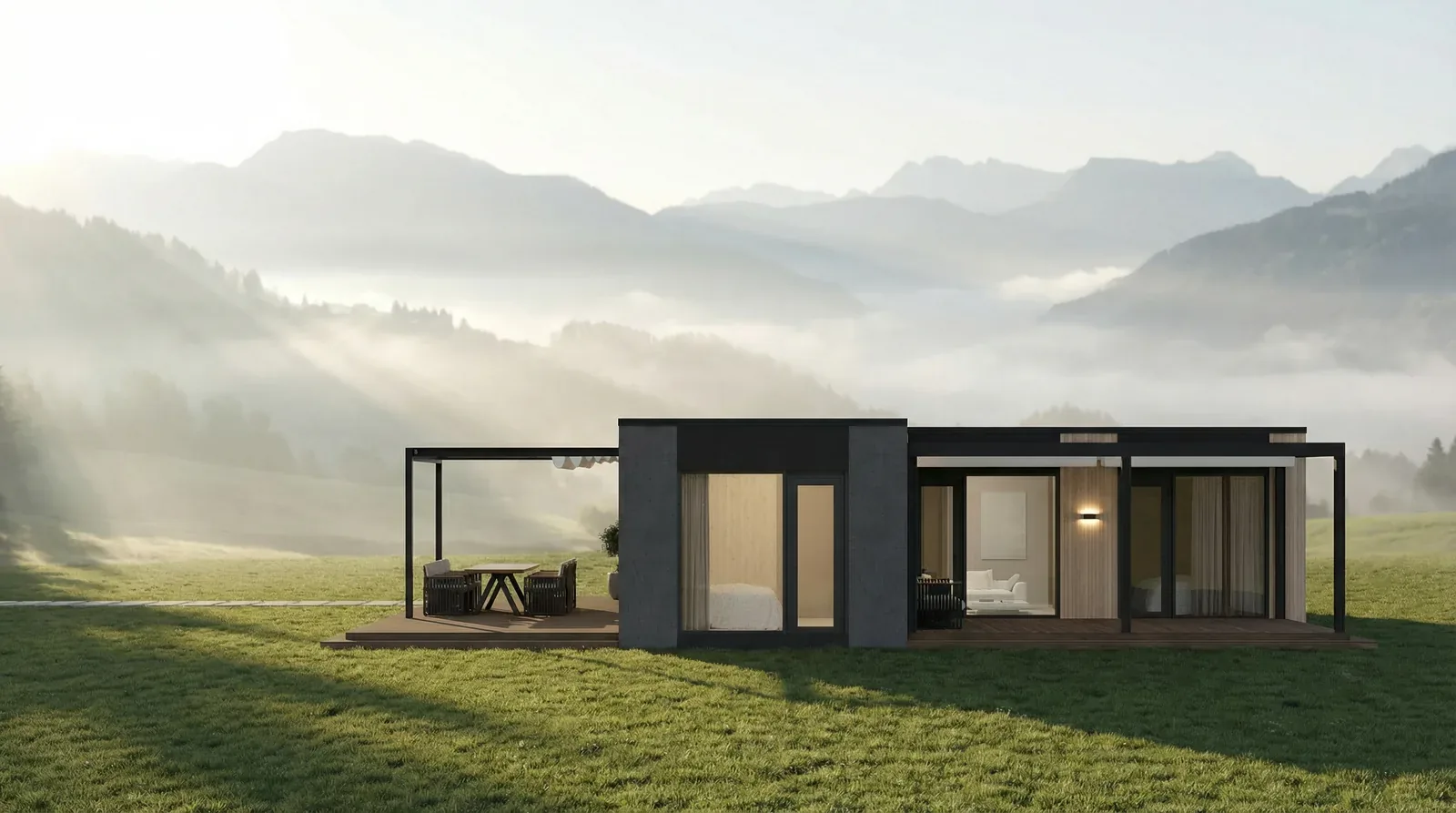
Mantra, Lumen and Alpina are practical candidates for hotel-room automation because the operator can standardize access, climate and sensor packages across repeated units. Larger homes such as Delta need more zoning and a stronger network plan, but they can also deliver premium comfort and lower energy waste.
Do not automate what you cannot maintain
Every device should have a reason, an owner and a backup process. That matters more than adding the newest gadget.
Automation scenario
A five-unit glamping project can use a PMS to issue codes, set pre-arrival heating, lower temperature after check-out and notify staff if humidity rises. The same logic can trigger cleaning tasks, protect empty units and create a consistent guest experience without an on-site reception desk.
Automation implementation workflow
Build the smart stack in layers. Layer one is connectivity and power continuity. Layer two is access, climate and safety sensors. Layer three is PMS, booking or owner dashboard integration. Layer four is optimization: automated temperature setbacks, maintenance prediction and usage reporting. For repeated units such as Mantra or Lumen, standardization matters more than novelty.
Every device should have a written fallback: manual key, offline code, local thermostat access, sensor reset process and one responsible administrator. That is how AI and automation stay useful when guests arrive late, Wi-Fi drops or staff changes.
System comparison
Use this checklist as a first filter before requesting a final configuration.
- map the guest or owner journey before buying devices
- choose one access-control method and document backup entry
- connect climate control to occupancy and weather logic
- monitor leaks, humidity and COв‚‚ before problems become reviews
- keep passwords, roles and device ownership under one operator policy
Common mistake
The common mistake is buying separate smart devices without an operating policy. A smart Mantra room should have one owner for access codes, climate presets, sensor alerts, battery backups and data security. Otherwise automation becomes another maintenance burden instead of a management tool.
QHOME-specific recommendation
For smart operation, QHOME models should be specified with device ownership, network reliability and maintenance access in mind before the first unit is installed.
- Mantra — 104 m², from €64,200; best fit: premium single-storey family home with covered terrace and integrated one-car carport.
- Lumen — 90.19 m², from €54,110; best fit: restrained modular solution with timber slats, fiber-cement panels and efficient permanent-living layout.
- Alpina — 29.11 m², from €59,800; best fit: turnkey micro-chalet for glamping and hotel-room use with panoramic lounge and GearBox.
- Delta — 26.2–38 m² + terrace, from €21,600; best fit: compact scenic modular home for couples, guest accommodation and glamping projects.
- Magnum — 52.54 m², from €26,910; best fit: revenue-ready modular home with panoramic end glazing and autonomous systems.
Decision checklist
- map the guest or owner journey before buying devices
- choose one access-control method and document backup entry
- connect climate control to occupancy and weather logic
- monitor leaks, humidity and COв‚‚ before problems become reviews
- keep passwords, roles and device ownership under one operator policy
Questions to ask before the quote
- Who owns the smart-home admin accounts and backup access?
- Which devices must work if the internet connection fails?
- How will PMS, smart locks, climate and sensors exchange data?
- What alerts go to staff, and what alerts go to guests?
- How will passwords, roles and device replacement be managed over time?
Reference notes
- QHOME.EU catalog — Product categories, areas, price ranges and scenarios.
- European Commission — Energy Performance of Buildings Directive — EU building energy performance context.
- European Commission — Smart Readiness Indicator — Smart building readiness context.
Frontier technology upgrades for remote climate control modular home in 2026
The newest and most interesting technologies for remote climate control modular home should be presented in three levels: available now, premium or limited, and watchlist. This keeps the article exciting without promising systems that are not yet bankable, serviceable or legal in the target country.
For remote land, the technical package must be designed as one ecosystem: energy, water, sanitation, internet and service access. The coolest device fails if it cannot be maintained locally.
What is worth mentioning now
| Technology | 2026 status | Why it is exciting | Main caution | QHOME fit |
|---|---|---|---|---|
| Matter + Thread smart home backbone Matter smart home modular home | available / practical premium | Matter and Thread make smart modular homes easier to integrate across ecosystems instead of locking every device into one vendor stack. | not every device category is equally mature | Mantra, Lumen, Alpina, Delta |
| Edge AI occupancy and energy control edge AI modular home | premium / software-led | Edge AI can reduce cloud dependence and respond locally to occupancy, climate and equipment data, improving privacy and resilience. | bad commissioning can irritate guests | Alpina, Mantra, Lumen, Delta |
| Digital twin and equipment passport digital twin modular home | premium / delivery-ready | A useful digital twin is not a 3D toy; it is a service record containing equipment, serial numbers, warranties, maintenance intervals and QR codes. | requires data discipline | Mantra, Lumen, Delta, Magnum |
| Cybersegmented network for smart modular homes cybersecurity modular home IoT | available / practical | Smart homes and modular hotels need separate networks for guests, owner systems, locks, cameras, sensors and energy equipment. | cybersecurity is operational, not only technical | Alpina, Delta, Mantra, Lumen |
| Predictive maintenance dashboard predictive maintenance modular home | available / operations-led | Predictive maintenance connects water, HVAC, battery, access and IAQ data so operators fix issues before guests complain. | alerts without responsibility become noise | Delta, Alpina, QBBQ, Mantra |
Do not oversell the future
The safest editorial rule: if a technology is a pilot, lab record or infrastructure concept, describe it as a watchlist option. Do not put it into a buyer checklist until the supplier, warranty, installation route and local approval are clear.
- Matter + Thread smart home backbone: Buying random smart devices that cannot talk to each other or be maintained.
- Edge AI occupancy and energy control: Automating comfort so aggressively that guests or residents feel controlled.
- Digital twin and equipment passport: Calling any render or floor plan a digital twin.
Decision checkpoints before adding frontier tech to a quote
- Matter + Thread smart home backbone: Choose Matter/Thread-compatible devices where possible and document the network.
- Edge AI occupancy and energy control: Use AI to assist comfort and maintenance, with manual override always available.
- Digital twin and equipment passport: Build the twin around maintenance and asset data, not only visualization.
- Cybersegmented network for smart modular homes: Segment networks and document admin access before launch.
- Separate “available now” items from “future-ready” preparation in the article and in the commercial conversation.
- Confirm local installer availability, service response time and warranty transfer before recommending the system to a private buyer or hospitality operator.
QHOME-specific recommendation
QHOME scenario: start with the model and use case, then select the frontier package. Mantra, Lumen, Alpina, Delta, Zephyr, Magnum can support different levels of technology, but the quote should separate available-now systems from premium-limited and watchlist options.
Reference signals behind this 2026 technology layer
- Connectivity Standards Alliance — Matter
- The Verge — Matter 1.4.1 setup improvements
- IEA Global Energy Review 2026 — Battery storage
- European Commission — Energy Performance of Buildings Directive
- European Commission — Circular systems can drive reductions in city freshwater use
FAQ
What is the main value of remote climate control modular home?
The main value is remote control and operational reliability: access, climate, leak detection, humidity, energy monitoring, maintenance alerts and smoother guest communication.
Which QHOME models fit smart hotel-room operation?
Mantra, Lumen and Alpina are strong candidates because compact hospitality units benefit directly from self check-in, climate presets and maintenance alerts.
Is a smart modular home more expensive to maintain?
It can be if devices are unmanaged. A simple documented system with stable connectivity, backups and clear ownership usually lowers service cost instead of increasing it.
Do I need PMS integration for one module?
For one private guest unit it may be optional. For several rental units, PMS integration helps manage codes, cleaning schedules, occupancy and pricing discipline.
What smart feature should be installed first?
Start with reliable access control, then climate control, leak/humidity sensors and energy monitoring. Entertainment features should come after the operational layer.