
Start with the load profile
The correct design for winter modular home starts with loads: heating, cooling, hot water, appliances, lighting, Wi-Fi, pumps and guest habits. A compact Alpina may need a very different system from Atak. The model should be selected together with energy expectations, not after them.
Season and behavior matter
Winter weekends, summer cooling peaks, cloudy weeks and full occupancy change the calculation. A battery that feels large in July can be insufficient in December.
Energy and utility system design
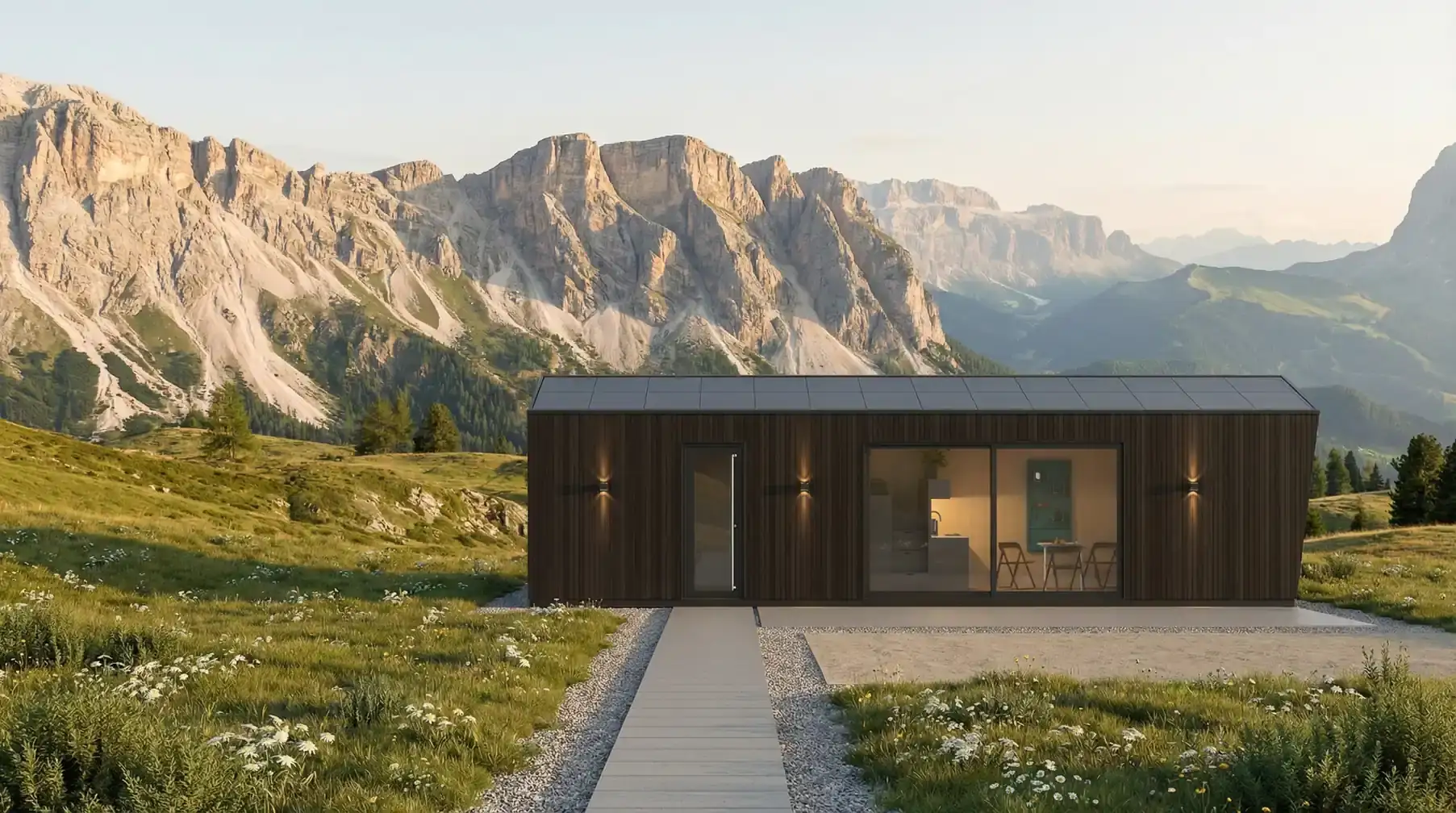
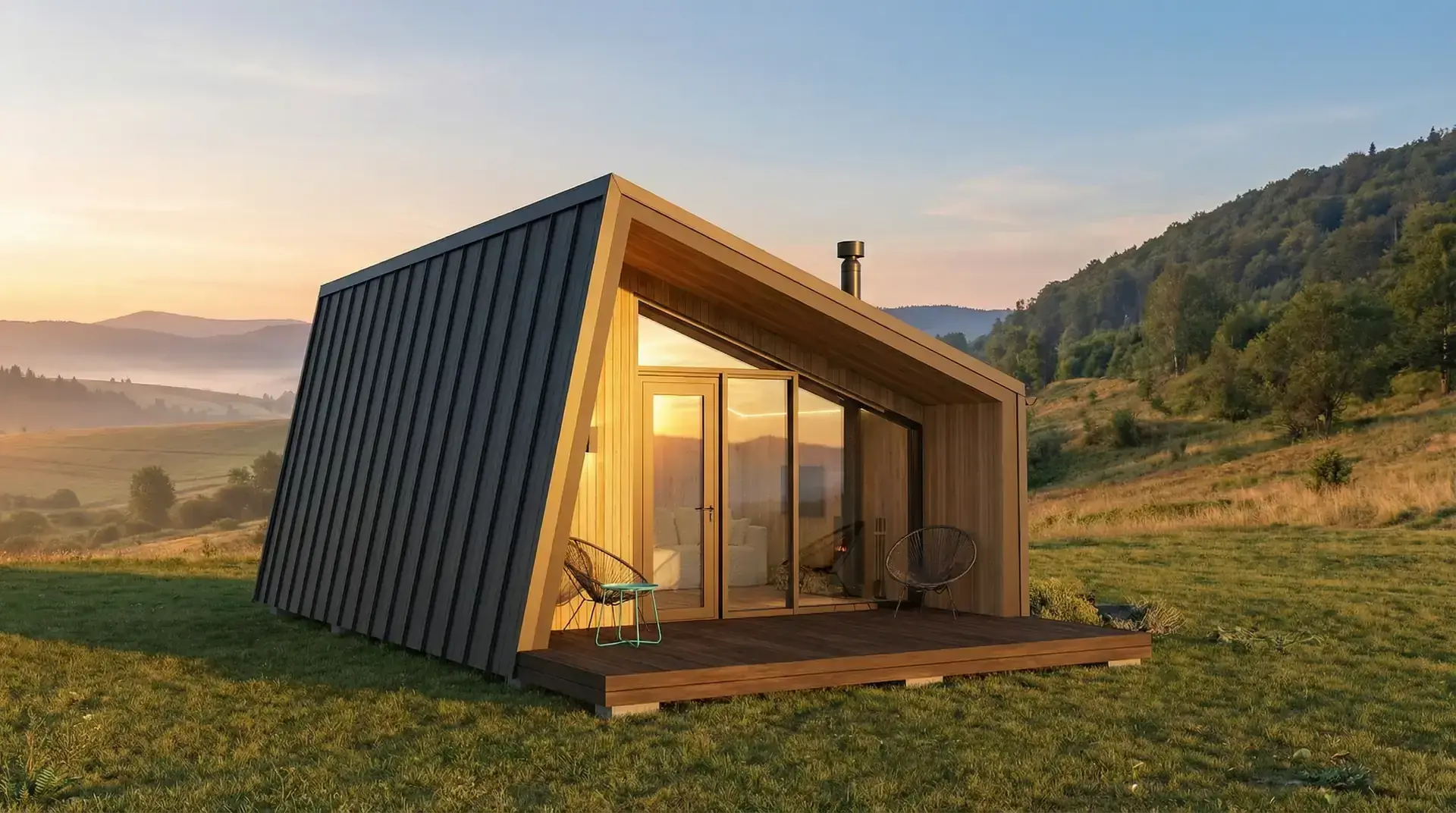
Alpina already shows how technical storage can be integrated into a compact hospitality product. Delta and Magnum can support scenic off-grid stays when heating, water and service access are realistic. Larger homes need more roof/interface planning and careful HVAC selection.
Monitor before you optimize
Energy meters, humidity sensors and water-level monitoring help an owner understand real use and prevent guest discomfort.
Practical off-grid scenario
For a remote lake plot, the owner might select Alpina as a premium compact stay, add battery reserve and plan water storage. If a family unit is needed, Atak can work, but it should be treated as a larger energy project with clearer backup and maintenance access.
Sizing and commissioning workflow
The sizing workflow begins with a consumption schedule: what runs in the morning, evening, hot weather, cold weather and empty periods. Then divide loads into essential, comfort and optional categories. Essential loads include safety, ventilation, water pumps and basic lighting. Comfort loads include HVAC, hot water and cooking. Optional loads include entertainment, outdoor lighting and service equipment.
For Alpina or Delta, compact loads may be manageable with a lean system. Larger models such as Atak need a more robust technical package, monitoring and backup plan. Commissioning should include a real-use test, not only a design calculation.
System checklist
The table below gives a practical comparison lens for this topic. It is not a substitute for a site-specific quote, but it helps frame the first conversation.
| QHOME model | Area | Starting price | Best use |
|---|---|---|---|
| Alpina | 29.11 m² | from €59,800 | permanent living |
| Delta | 26.2–38 m² + terrace | from €21,600 | guest accommodation |
| Magnum | 52.54 m² | from €26,910 | glamping / hospitality |
| Atak | 20–35 m² | from €11,660 | outdoor revenue |
Common mistake
The common mistake is starting with solar panels instead of loads. A compact Alpina may be easier to support off-grid than a larger family home, but heating, cooling, hot water, cooking, guest behavior and backup access decide the system size. Autonomy is a calculation, not a label.
QHOME-specific recommendation
For this topic, QHOME models should be compared by scenario rather than by size alone. The right unit is the one that reduces project risk and matches daily use.
- Alpina — 29.11 m², from €59,800; best fit: turnkey micro-chalet for glamping and hotel-room use with panoramic lounge and GearBox.
- Delta — 26.2–38 m² + terrace, from €21,600; best fit: compact scenic modular home for couples, guest accommodation and glamping projects.
- Magnum — 52.54 m², from €26,910; best fit: revenue-ready modular home with panoramic end glazing and autonomous systems.
- Atak — 20–35 m², from €11,660; best fit: compact minimalist home for two people with functional layout and landscape integration.
- Mantra — 104 m², from €64,200; best fit: premium single-storey family home with covered terrace and integrated one-car carport.
Decision checklist
- calculate consumption before sizing solar panels or batteries
- separate heating/cooling load from lighting and appliances
- plan backup power and service access for bad-weather weeks
- monitor water, wastewater and humidity as operational systems
- avoid promising full autonomy without a seasonal energy model
Questions to ask before the quote
- What are the expected summer, winter and shoulder-season loads?
- Which loads are essential during bad weather or outage conditions?
- How will water, wastewater and freezing risk be managed?
- What monitoring will prove the system is working?
- What backup plan exists when guests use more energy than expected?
Reference notes
- QHOME.EU catalog — Product categories, areas, price ranges and scenarios.
- European Commission — Energy Performance of Buildings Directive — EU building energy performance context.
Frontier technology upgrades for winter modular home in 2026
The newest and most interesting technologies for winter modular home should be presented in three levels: available now, premium or limited, and watchlist. This keeps the article exciting without promising systems that are not yet bankable, serviceable or legal in the target country.
For a glamping operator, the strongest frontier technologies are not the most exotic ones; they are the systems that reduce complaints, automate service alerts and keep guest units comfortable when the site is full.
What is worth mentioning now
| Technology | 2026 status | Why it is exciting | Main caution | QHOME fit |
|---|---|---|---|---|
| R290 propane heat pump R290 heat pump modular home | available / fast-growing premium | R290 heat pumps use a low-GWP natural refrigerant and are becoming a strong premium option for electrified heating in European homes. | safety rules and installer competence matter | Mantra, Lumen, Zephyr, Element |
| CO2 / R744 heat-pump water heater CO2 heat pump water heater modular home | premium / specialist | CO2 heat-pump water heaters can produce high hot-water temperatures efficiently and are interesting for hospitality or service modules with predictable demand. | equipment cost and installer familiarity vary | QBBQ, Mantra, Forza, Sofia |
| Heat-pump water heater with smart load shifting smart heat pump water heater modular home | available now / practical | Smart heat-pump water heaters can act like a small thermal battery by heating water when solar is available or tariffs are lower. | oversized tanks waste space; undersized tanks create complaints | Mantra, Sofia, Forza, QBBQ |
| Demand-controlled MVHR with CO2 / VOC sensors smart MVHR modular home | available / premium | Airtight modular homes need controlled fresh air; premium MVHR adds CO2/VOC sensing and adapts ventilation to occupancy instead of running blindly. | duct design, noise and maintenance filters matter | Mantra, Lumen, Zephyr, Element |
| N-type TOPCon high-efficiency PV TOPCon solar panels modular home | available now / practical premium | TOPCon is a realistic high-performance solar option today: less speculative than tandem PV and easier to specify for rooftops or carports. | roof orientation, shading, wind uplift and warranty details matter more than label hype | Mantra, Lumen, Element, Delta |
Do not oversell the future
The safest editorial rule: if a technology is a pilot, lab record or infrastructure concept, describe it as a watchlist option. Do not put it into a buyer checklist until the supplier, warranty, installation route and local approval are clear.
- R290 propane heat pump: Mentioning R290 as a buzzword without explaining safety, siting and installer requirements.
- CO2 / R744 heat-pump water heater: Specifying a complex hot-water system for a single low-use cabin.
- Heat-pump water heater with smart load shifting: Treating hot water as a minor detail in hospitality projects.
Decision checkpoints before adding frontier tech to a quote
- R290 propane heat pump: Use where electrified heating, low-GWP refrigerant and skilled installation align.
- CO2 / R744 heat-pump water heater: Use for high hot-water demand, not for every tiny module.
- Heat-pump water heater with smart load shifting: Size hot water by guest routines, cleaning cycles and solar/load-shift strategy.
- Demand-controlled MVHR with CO2 / VOC sensors: Specify airflow, acoustic comfort, filters and service intervals together.
- Separate “available now” items from “future-ready” preparation in the article and in the commercial conversation.
- Confirm local installer availability, service response time and warranty transfer before recommending the system to a private buyer or hospitality operator.
QHOME-specific recommendation
Resilience scenario: use Mantra, Lumen or Alpina with solar-ready routing, a monitored LFP battery, rainwater telemetry and a clear sanitation pathway. Keep perovskite, sodium-ion and MOF water harvesting as watchlist upgrades unless locally available.
Reference signals behind this 2026 technology layer
- IEA Global Energy Review 2026 — Heat pumps
- European Heat Pump Association — 2025 sales preliminary data
- European Commission — Solar energy in buildings
- European Commission — Energy Performance of Buildings Directive
FAQ
How should I start planning winter modular home?
Start with a load profile: heating, cooling, hot water, cooking, lighting, appliances, guest behavior, backup needs and service access. Only then size panels, batteries or tanks.
Which QHOME models suit off-grid projects?
Alpina, Delta and Magnum are useful references. Compact modules are easier to make semi-autonomous, while larger homes need a more robust energy and water plan.
Can solar panels power a modular home all year?
Sometimes, but it depends on climate, roof area, shading, heating system, battery reserve and user behavior. Winter and shoulder-season conditions must be modelled separately.
What is the biggest off-grid risk?
The biggest risk is undersizing the system for bad weather, peak occupancy or heating demand. A backup strategy and monitoring are essential.
Should water and wastewater be planned with energy?
Yes. Pumps, tanks, septic systems, treatment, freeze protection and maintenance access can affect both reliability and operating cost.